Kubernetes Platform Engineering Services for Enterprise: Build Production-Ready K8s Platforms
Transform your Kubernetes infrastructure into a self-service developer platform with Maven Solutions' enterprise-grade Kubernetes platform engineering services. Our Kubestronaut-certified engineers design, implement, and optimize Kubernetes platforms that reduce deployment complexity by 80% while maintaining enterprise security and compliance standards.


Why Kubernetes Platform Engineering Matters for Enterprise Organizations
Kubernetes has become the standard for container orchestration, with over 60% of enterprises adopting it for production workloads. However, raw Kubernetes is complex—it provides powerful primitives but requires significant expertise to operate safely at scale.
Kubernetes platform engineering transforms raw Kubernetes clusters into developer-friendly platforms by:
Abstracting complexity – Developers deploy applications without learning Kubernetes YAML or understanding cluster internals
Enforcing standards – Security policies, resource limits, and best practices are baked into the platform
Enabling self-service – Teams provision namespaces, deploy applications, and manage environments without ticket-ops
Improving observability – Integrated monitoring, logging, and tracing provide visibility into application and cluster health
Our Enterprise Kubernetes Platform Engineering Services
1. Kubernetes Platform Assessment & Architecture Design
- Multi-cluster strategy for production, staging, and development environments
- Multi-tenancy model with namespace isolation, network policies, and RBAC
- Disaster recovery and business continuity planning
- Cost optimization through right-sizing, autoscaling, and resource governance
- Security hardening following CIS Kubernetes benchmarks and compliance requirements


2. Platform Tooling Integration & Developer Experience
- GitOps workflows with ArgoCD or Flux for declarative deployments
- Service mesh (Istio, Linkerd) for traffic management, security, and observability
- Developer portals (Backstage, Port) for self-service and discoverability
- Policy engines (OPA, Kyverno) for security and compliance guardrails
- Observability stack (Prometheus, Grafana, Loki) for metrics, logs, and traces
- Secret management (Vault, External Secrets Operator) for secure credential handling
3. Security & Compliance Hardening
- Pod Security Standards (PSS) implementation with admission controllers
- Network segmentation with NetworkPolicies and service mesh authorization
- Container image scanning and signing with Sigstore/Cosign
- Runtime security monitoring with Falco or similar tools
- Audit logging and compliance reporting for SOC 2, HIPAA, PCI-DSS
- Zero-trust networking with mTLS and identity-based access control
4. Platform Operations & Day-2 Optimization
- Cluster upgrade automation with minimal downtime
- Capacity planning and performance tuning
- Cost allocation and chargeback mechanisms
- Platform SLO definition and monitoring
- Incident response playbooks and runbooks






Kubernetes Platform Engineering for Multi-Cloud & Hybrid Environments
Modern enterprises often operate across multiple cloud providers and on-premises data centers. Our Kubernetes platform engineering services support:
Multi-Cloud Kubernetes Platforms
Consistent developer experience across AWS EKS, Azure AKS, and Google GKE
Cross-cluster service discovery and traffic management
Unified security policies and governance across clouds
Cost optimization through intelligent workload placement

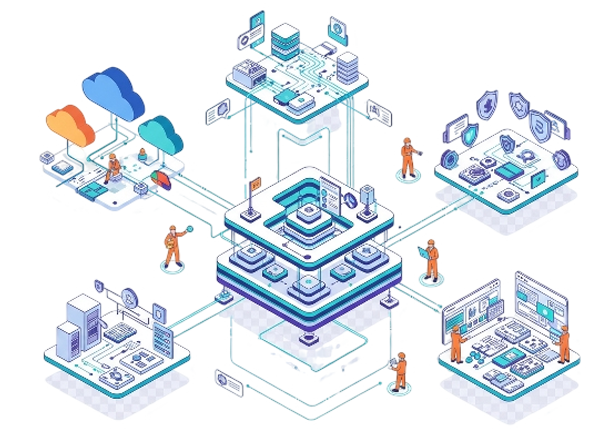
Hybrid Cloud Kubernetes Platforms
Integration between cloud-managed Kubernetes and on-premises clusters
Edge computing platforms for distributed deployments
Data sovereignty and compliance-driven workload placement
Consistent networking and security across cloud and on-prem
Case Study: Global financial services company with 300+ microservices across AWS, Azure, and on-premises data centers. Maven Solutions implemented a unified Kubernetes platform with:
- 5-cluster federated architecture (2 AWS, 2 Azure, 1 on-prem)
- Service mesh for cross-cluster communication
- GitOps-based deployment automation
- Centralized observability and security monitoring
Results: Results: 65% reduction in deployment time, 40% cost savings through optimization, zero security incidents in first 18 months
Kubernetes Platform Maturity: Where Does Your
Organization Stand?
We assess Kubernetes platform maturity across five levels:
Level 1: Basic Kubernetes (Ad-Hoc)
Kubernetes clusters deployed but little standardization
Manual deployment processes with kubectl commands
Limited monitoring and observability
Security policies inconsistently applied
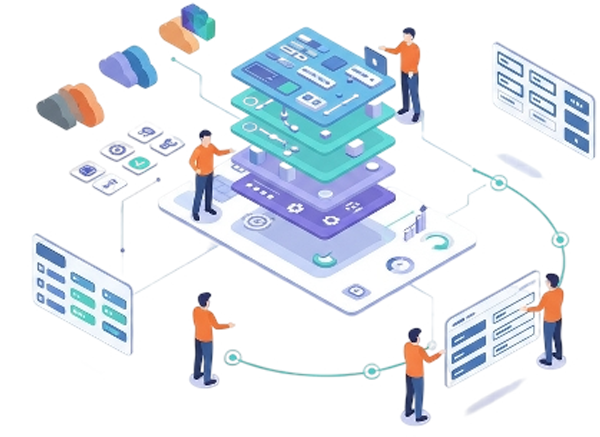
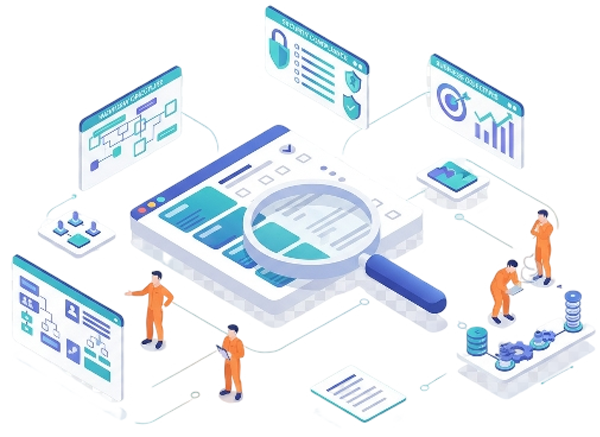
Level 2: Managed Kubernetes (Repeatable)
Managed Kubernetes services (EKS, AKS, GKE) in use
Basic CI/CD pipelines for deployments
Namespace-based multi-tenancy
Prometheus/Grafana for monitoring
Level 3: Platform Foundations (Defined)
GitOps workflows with ArgoCD or Flux
Service mesh for traffic management
Policy enforcement with admission controllers
Developer self-service for common tasks
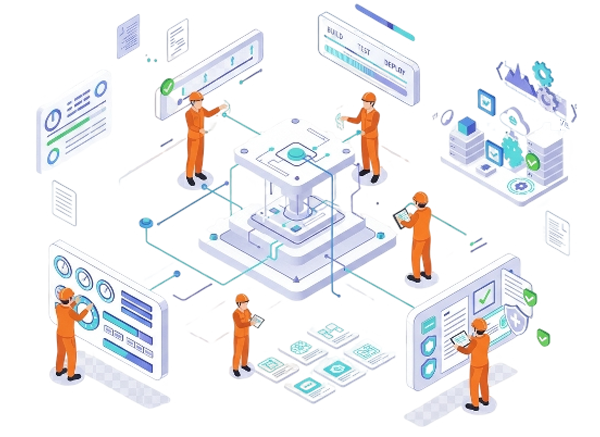

Level 4: Developer Platform (Managed)
Self-service developer portal (Backstage, Port)
Golden path templates for common architectures
Automated compliance and security scanning
Platform SLOs with automated alerting
Level 5: Platform Product (Optimizing)
Platform treated as internal product with roadmap
Continuous improvement based on developer feedback
Advanced capabilities (progressive delivery, chaos engineering)
Platform contributes to business KPIs

Kubernetes Platform Engineering FAQs
What's the difference between DevOps and Kubernetes platform engineering?
DevOps is a cultural methodology focusing on collaboration between development and operations teams. Kubernetes platform engineering is the practice of building self-service platforms on top of Kubernetes that implement DevOps principles at scale. Platform engineering provides the tooling and processes that make DevOps practices accessible to all developers, not just those with deep Kubernetes expertise.
Should we use managed Kubernetes (EKS/AKS/GKE) or self-managed clusters?
For most enterprises, managed Kubernetes services are the right choice. They provide automatic control plane upgrades, built-in high availability, and reduced operational overhead. We recommend managed Kubernetes unless you have specific requirements around data sovereignty, control plane customization, or hybrid cloud architectures that necessitate self-managed clusters.
How do you handle Kubernetes security for enterprise compliance requirements?
We implement defense-in-depth security across multiple layers: (1) Infrastructure security with private clusters and network isolation, (2) Pod-level security with Pod Security Standards and admission controllers, (3) Runtime security with container scanning and anomaly detection, (4) Data security with encryption at rest and in transit, (5) Identity and access management with RBAC and service mesh authorization, (6) Audit logging and compliance reporting. We align all controls with frameworks like CIS Kubernetes Benchmark, SOC 2, HIPAA, and PCI-DSS.
What's involved in migrating existing applications to a Kubernetes platform?
Application migration typically follows a phased approach: (1) Assessment of applications for cloud-native readiness, (2) Containerization of applications not already containerized, (3) Kubernetes manifest creation or Helm chart development, (4) CI/CD pipeline integration, (5) Testing in non-production environments, (6) Gradual production rollout with canary deployments. We help prioritize applications based on business value and migration complexity, often starting with stateless applications before moving to stateful workloads.
How do you optimize Kubernetes costs at enterprise scale?
Cost optimization is multi-faceted: (1) Right-sizing pods based on actual resource usage, (2) Implementing Horizontal and Vertical Pod Autoscaling, (3) Using Cluster Autoscaler for node-level scaling, (4) Leveraging spot/preemptible instances for non-critical workloads, (5) Implementing resource quotas and limit ranges, (6) Chargeback mechanisms for cost accountability, (7) Multi-tenant cluster design to improve utilization. We typically see 30-50% cost reduction through comprehensive optimization.

About Our Kubernetes Expertise
Maven Solutions' platform engineering team includes multiple Kubestronaut-certified engineers (holding all five Kubernetes certifications: CKA, CKAD, CKS, KCNA, KCSA). We've designed and deployed Kubernetes platforms for Fortune 500 enterprises across financial services, healthcare, retail, and technology sectors. Our team maintains active contributions to CNCF projects and stays current with the rapidly evolving Kubernetes ecosystem.
Connect with a Kubernetes Expert

Andrew Korolov


About your meeting
1. Describe Your Challenge & Vision
2. Share Your Business Goals
3. Get Your Kubernetes Roadmap